
Ba Ngôi Đức Chúa Trời (Trinity)—part 4
Vietnamese Theological Review has some helpful posts. Here’s an excerpt about the Trinity:
Question: ‘I hear people say that Protestants say that there is only one God but there is a Trinity. I really don’t understand. Please explain for me. Thank you.’
‘Tôi nghe những người Tin Lành nói rằng chỉ có Một Đức Chúa Trời nhưng có Ba Ngôi: Đức Chúa Cha, Đức Chúa Con và Đức Thánh Linh, tôi thật sự không hiểu. Xin vui lòng giải thích giùm tôi. Xin cảm ơn.’
Answer: ‘Cảm ơn Chúa cho Bạn thính giả đã có câu hỏi thuộc vào loại khó nhất trong các lẽ đạo của người Tin Lành. Quả đúng như vậy, theo sự mặc khải của Đức Chúa Trời trong Kinh thánh, Đức Chúa Trời mà người Tin Lành tin và thờ phượng là Đức Chúa Trời có Ba Ngôi nhưng Hiệp Một, đồng đẳng, đồng quyền, đồng thể yếu, bất phân ly. Nói tóm một lời là Ba Mà Là Một, Một Mà Là Ba!
‘I. Tôi xin nói về TẦM QUAN TRỌNG CỦA LẼ ĐẠO ĐỨC CHÚA TRỜI BA NGÔI:
‘Sở dĩ tôi nói đây là câu hỏi thuộc loại khó nhất trong các lẽ đạo là như câu nói của nhà Thần học…
‘1. Nếu không tin Đức Chúa Trời Ba Ngôi thì mất sự cứu rỗi….
‘2. Nếu càng cố cậy khôn ngoan loài người để giải thích Đức Chúa Trời Ba Ngôi thì mất linh hồn….’
Ba Ngôi Đức Chúa Trời (Trinity: Outline)—part 3
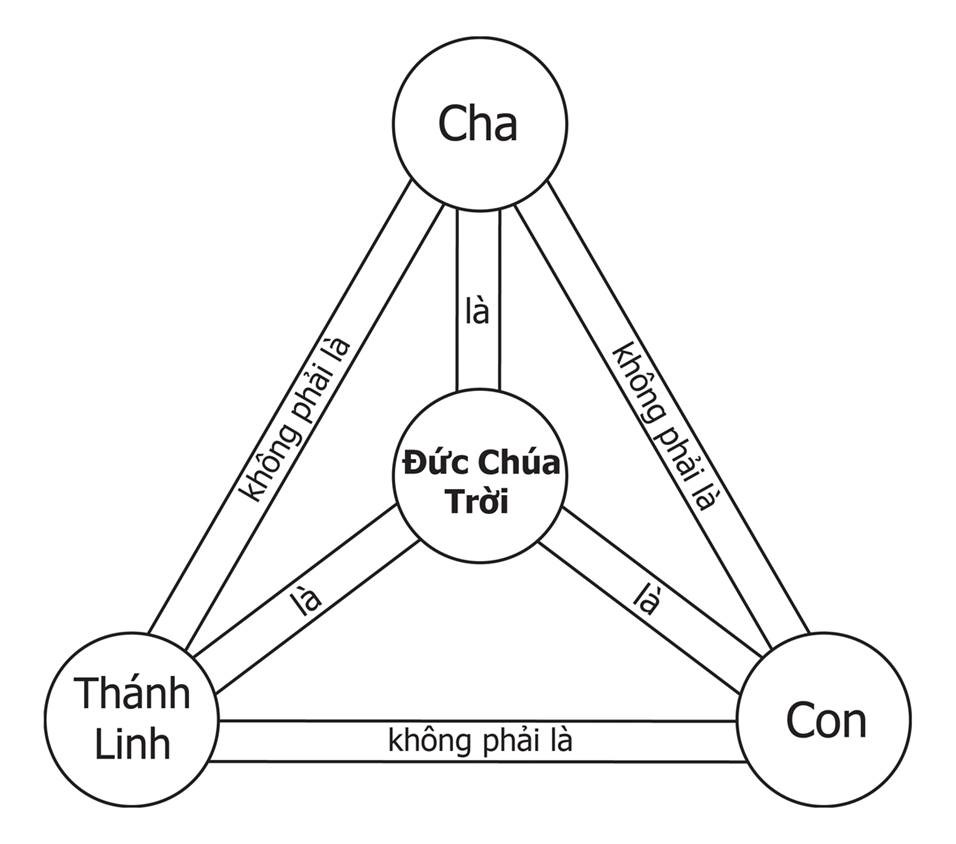
The Trinity
There is one God
Deuteronomy 6:4, “Hear, O Israel! The Lord our God, the Lord is one.”
The Father is God
Ephesians 1:3, “Blessed be the God and Father of our Lord Jesus Christ.”
The Son is God
Colossians 2:9, “For in Him all the fullness of Deity dwells in bodily form.”
The Spirit is God
Acts 5:3-4, “But Peter said, ‘Ananias, why has Satan filled your heart to lie to the Holy Spirit . . . ? You have not lied to men, but to God.'”
The Father is not the Son
John 3:16, “God so loved the world that He gave His only begotten son. . . .”
The Son is not the Spirit
John 14:16, “I will ask the Father, and He will give you another Helper.”
The Spirit is not the Father
John 14:26, “But the Helper, the Holy Spirit, whom the Father will send in my name. . . .”
The Father is a Person
Luke 22:42, “Father, if You are willing, remove this cup from Me; yet not My will, but Yours be done.”
The Son is a Person
Ephesians 5:25, “Christ also loved the church.”
The Spirit is a Person
Ephesians 4:30, “Do not grieve the Holy Spirit of God. . . .”
Ba Ngôi
(revised 2023)
Chỉ có một Thiên Chúa, đó là Đức Chúa Trời
Phục Truyền 6:4, “Hỡi Y-sơ-ra-ên! hãy nghe: Giê-hô-va Đức Chúa Trời chúng ta là Giê-hô-va có một không hai.”
Đức Chúa Cha là Đức Chúa Trời
Ê-phê-sô 1:3, “Ngợi-khen Đức Chúa Trời, Cha Đức Chúa Jêsus-Christ chúng ta, Ngài đã xuống phước cho chúng ta trong Đấng Christ đủ mọi thứ phước thiêng-liêng ở các nơi trên trời,”
Đức Chúa Con là Đức Chúa Trời
Cô-lô-se 2:9, “Vì sự đầy-dẫy của bổn-tánh Đức Chúa Trời thảy đều ở trong Đấng ấy như có hình.”
Đức Chúa Thánh Linh là Đức Chúa Trời
Công Vụ 5:3-4, “Phi-e-rơ bèn nói với người rằng: Hỡi A-na-nia, sao quỉ Sa-tan đã đầy-dẫy lòng ngươi, đến nỗi ngươi nói dối cùng Đức Thánh-Linh . . . ? chẳng phải ngươi nói dối loài người, bèn là nói dối Đức Chúa Trời.”
Đức Chúa Cha không phải là Đức Chúa Con
Giăng 3:16, “Vì Đức Chúa Trời yêu-thương thế-gian, đến nỗi đã ban Con một của Ngài, hầu cho hễ ai tin Con ấy không bị hư-mất mà được sự sống đời đời.”
Đức Chúa Con không phải là Đức Chúa Thánh Linh
Giăng 14:16, “Ta lại sẽ nài-xin Cha, Ngài sẽ ban cho các ngươi một Đấng Yên-ủi khác, để ở với các ngươi đời đời,”
Đức Chúa Thánh Linh không phải là Đức Chúa Cha
Giăng 14:26, “Nhưng Đấng Yên-ủi, tức là Đức Thánh-Linh mà Cha sẽ nhân danh ta sai xuống . . . .”
Đức Chúa Cha là một ngôi
Lu-ca 22:42, “Lạy Cha, nếu Cha muốn, xin cất chén nầy khỏi tôi! Dầu vậy, xin ý Cha được nên, chớ không theo ý tôi!…”
Đức Chúa Con là một ngôi
Ê-phê-sô 5:25, “Hỡi người làm chồng, hãy yêu vợ mình, như Đấng Christ đã yêu Hội-thánh. . . .”
Đức Chúa Thánh Linh là một ngôi
Ê-phê-sô 4:30, “Anh em chớ làm buồn cho Đức Thánh-Linh của Đức Chúa Trời, vì nhờ Ngài anh em được ấn-chứng đến ngày cứu-chuộc.”
Ba Ngôi Đức Chúa Trời (Trinity)—part 2
Illustrations about the Trinity
When it comes to illustrating the Trinity it is best not to. Typically illustrations will teach more error than truth.
Below is one teacher’s WRONG teachings about the theology of the Trinity
‘Water may serve as a “three-in-one” illustration since it retains its chemical activity whether in solid, gas, or liquid state. There is also a triple point for water, a condition under which ice, steam, and liquid water can coexist in equilibrium. All are water, yet distinct from each other.’
Dưới đây là đánh giá SAI của một thầy về thần học của Ba Ngôi Đức Chúa Trời
‘Nước có thể minh họa “ba trong một” vì giữ lại được những hoạt tính hóa học của nó dầu ở dạng rắn, hơi, hay lỏng. Cũng có một điểm bộ ba mà tại đó tình trạng nước đá, hơi nước và nước dạng lỏng đồng tồn tại trong trạng thái cân bằng. Cả thảy đều là nước nhưng khác biệt với nhau.’
-Charles Ryrie, Basic Theology, p. 63 / Thần Học Căn Bản, p. 67
Ba Ngôi Đức Chúa Trời (Trinity)—part 1
Our churches are not Christian if they aren’t Trinitarian. Does your church embrace all that the Bible teaches about God’s one-ness and his three-ness?
‘1) There is one God (Deuteronomy 6:4; 1 Corinthians 8:4; Galatians 3:20; 1 Timothy 2:5).
‘2) The Trinity consists of three Persons (Genesis 1:1, 26; 3:22; 11:7; Isaiah 6:8, 48:16, 61:1; Matthew 3:16-17, 28:19; 2 Corinthians 13:14).
‘3) The members of the Trinity are distinguished one from another in various passages.
‘4) Each member of the Trinity is God.
‘5) There is subordination within the Trinity.
‘6) The individual members of the Trinity have different tasks.’
‘1. Có một Đức Chúa Trời: Phục truyền luật lệ ký 6:4; 1 Cô-rinh-tô 8:4; Ga-la-ti 3:20; I Ti-mô-thê 2:5.
‘2. Đức Chúa Trời Ba ngôi gồm có ba thân vị.
‘3. Các thân vị trong Ba ngôi Đức Chúa Trời được phân biệt từng vị một trong nhiều chỗ trong Kinh Thánh.
‘4. Mỗi thân vị trong Ba ngôi là Đức Chúa Trời….
‘5. Sự lệ thuộc trong Ba ngôi Đức Chúa Trời….
‘6. Công tác của từng thân vị trong Ba ngôi….’
Teaching about Predestination
If you believe in predestination, and you should, then you should talk about it with Christians and encourage them to believe it too. Here’s one author’s helpful suggestions from an experience with high school students.
- ‘1. I highlighted that this side of heaven, there are going to be some things we simply don’t fully understand about God….
- ‘2. I also spent time talking about the truth (seen throughout the book of Romans) that makes it abundantly clear that God’s choosing me has absolutely nothing to do with me deserving to be chosen. We talked about the fact that if God chooses me, it is actually in spite of the fact that I deserve to go to hell.
- ‘3. We then talked about how amazing it is that God, in eternity past (even before creation), spent time thinking about me – choosing me….’
The author made another good point: ‘It also makes for a really hopeful discussion in Senior High Sunday School class where students don’t feel like they need to apologize for their God’s sovereign decisions.’
Researching Calvinism and Missions?
Consider these resources:
Van den Berg, “Calvin’s Missionary Message: Some Remarks About the Relation Between Calvinism and Missions,” Evangelical Missions Quarterly 22 (1950): 174-187.
Carr Sargant, “Calvinism, Arminianism and Missions,” London Quarterly and Holborn Review 176 (1951): 340-344.
M. Zwemer, “Calvinism and the Missionary Enterprise,” Theology Today 7 (1950): 206-221.
Kenneth J. Stewart, Ten Myths About Calvinism: Recovering the Breadth of the Reformed Tradition, 2011.
Also see these articles at GSiV:
“To the Ends of the Earth: Calvin’s Missional Vision and Legacy”
“Calvinism: fan a flame for God’s glory in missions”
Mối đe dọa đối với truyền giáo và truyền giảng? (Đoạn 24: Xem chi tiết)
Regeneration, God’s Grace, New Birth–Part 5
Sự Tái Sinh Bằng Quyết Định Là Gì?
What is “decisional regeneration”?
English
- Written: GSiV “Regeneration, God’s Grace, New Birth” (Parts 1, 2, 3, 4)
- Audio: Timothy Juhnke “Decisional Regeneration”
English and Vietnamese
- Written/Viết: GSiV “Discerning what Scripture says: Part 3”
Vietnamese (and some English)
- Viết: GSiV “Đức Chúa Trời và Sự Cứu Rỗi–9” (Đoạn 39, GSiV: Xem chi tiết)
- Viết: John Piper Sự Tái Sanh Sản Sinh Tình Yêu Thương 1 John 4:7-21
- Viết: John Piper Chúng ta như thế nào trong sự tái sanh 1 Peter 1:13-25
- Viết: John Piper Qua việc thanh tẩy của sự tái sanh Titus 3:1-8
- Viết: John Piper Được tái sanh qua Lời hằng sống 1 Peter 1:13-25
- Viết: John Piper Tại sao chúng cần phải sanh lại? Phần 2 1 John 1
- Viết: John Piper Tại sao chúng ta cần phải sanh lại? Phần 1 Ephesians 2:1-10
- Viết: John Piper Chuyện gì xảy ra khi được tái sanh? Phần 2 John 3:1-10
- Viết: John Piper Sự tái sanh xảy ra như thế nào? Phần 1 John 3:1-10
- Viết: John Piper Lý do vì sao Con Đức Chúa Trời hiện đến để hủy phá công việc của Ma quỷ Vì sao chúng ta cần phải tái sanh? Phần 3 1 John 3:1-10
Regeneration, God’s Grace, New Birth–Part 4
“We’ve been telling people the lie…that if you do this [pray a prayer], then God will make you born again. You see the only difference between baptismal regeneration and decisional regeneration is the new birth is just attached to a different act. On one it’s water and on the other it’s a prayer.”
-Audio: Timothy Juhnke “Decisional Regeneration,” Around the 27:00-29:00 minute point.
How Free is the Will?
Philadelphia Baptist Confession of Faith (1742)
Chapter 9: Of Free Will
- God hath endued the will of man with that natural liberty and power of acting upon choice, that it is neither forced, nor by any necessity of nature determined to do good or evil.[1 ]
- Man, in his state of innocency had freedom, and power, to will, and to do, that which was good, and well-pleasing to God;[2] but yet was mutable, so that he might fall from it.[3]
- Man, by his fall unto a state of sin, hath wholly lost all ability of will to any spiritual good accompanying salvation;[4] so as a natural man, being altogether averse from that good and dead in sin,[5] is not able, by his own strength, to convert himself or to prepare himself thereunto.[6]
- When God converts a sinner, and translates him into the state of grace, He freeth him from his natural bondage under sin,[7] and by His grace alone, enables him freely to will, and do that which is spiritually good;[8] yet so that, by reason of his remaining corruptions, he doth not perfectly nor only will that which is good, but doth also will that which is evil.[9]
- The will of man is made perfectly and immutably free to good alone in the state of glory only.[10]
Footnotes: 1. Mt 17:12; Jas 1:14; Dt 30:19; 2. Ecc 7:29; 3. Ge 3:6; 4. Ro 5:6; 8:7; 5. Eph 2:1,5; 6. Tit 3:3-5; Jn 6:44; 7. Col 1:13; Jn 8:36; 8. Php 2:13; 9. Ro 7:15,18-19,21,23; 10. Eph 4:13.
Tuyên Xưng Philadelphia (1742)
Đoạn 9: Về ý chí tự do
- Đức Chúa Trời đã phú cho con người bản chất tự do và năng lực hành động theo sự chọn lựa chủ quan, tức không hề bị thúc ép, cũng không phải bởi [a] một khuynh hướng hoặc thiện, hoặc ác nào quyết định.
- Trong trạng thái vô tội uyên nguyên con người đã từng có sự tự do và năng lực ý chí để làm theo những gì tốt và đẹp ý Đức Chúa Trời, nhưng năng lực và ý chí ấy ấy không hề bị cưỡng buộc cho nên con người không thể cứ luôn luôn làm theo điều tốt và làm điều đẹp ý Đức Chúa Trời.
- Trong trạng thái sa bại trong tội lỗi loài người đã mất hẳn [d] năng lực chọn lựa làm theo điều thiện là điều sẽ có sau khi đã được cứu cho nên người chưa được cứu không có khuynh hướng làm theo điều thiện cách tự nhiên, họ [e] đang chết trong tội lỗi mình, họ không có năng lực [f] tự biến cải mình hoặc tự chuẩn bị mình cho sự biến cải hướng về sự thiện hảo.
- Khi Đức Chúa Trời biến cải một tội nhân và đem người ấy vào trong ân điển Ngài thì [g] Ngài giải thoát họ khỏi ách tội vốn có, và chỉ duy nhất bằng ân điển của Ngài mà Đức Chúa Trời giải thoát họ để họ biết [h] vừa muốn vừa làm theo các sự thiện hảo thuộc linh; dẫu vậy, vì cớ [i] sức mạnh của tội lỗi vẫn cứ còn trong con người mình mà họ vẫn chưa được hoàn hảo và họ không chỉ muốn làm điều thiện mà cũng lại còn còn muốn làm theo điều ác nữa.
- Bản chất tự do và năng lực hành động [k] hoàn toàn theo điều thiện của con người chỉ được tái lập trong trạng thái vinh hiển khi họ được ở trong sự vinh hiển của Đức Chúa Trời mà thôi.
Lời chú ở cuối trang: [a] Ma. 17:12; Gia. 1:14; Phục. 30:19; [b] Truyền. 7:29; [c] Sáng. 3:6; [d] Rô. 5:6; 8:7; [e] Êph. 2:1, 5; [f] Tít 3:3, 4, 5; Gi. 6:44; [g] Côl. 1:13; Gi. 8:36; [h] Php. 2:13; [i] Rô. 7:15, 18, 19, 21, 22, 23; [k] Êph. 4:13
To the Ends of the Earth
“Does a belief in sovereign grace stymie missions and evangelism? If that belief is rightly understood and rightly applied, the answer is an emphatic no….”
-Jason K. Allen, President, Midwestern Baptist Theological Seminary and College
Too often those who least understand the biblical doctrine of Calvinism accuse Calvinists of a non-evangelistic spirit and practice. We do often wonder how frequently those same accusers share their faith with the lost. Nonetheless, the more we study church history the more we see that a life centered on God’s glory leads to passion and boldness for Christ’s mission.
To the Ends of the Earth: Calvin’s Missional Vision and Legacy
By Michael A. G. Haykin & C. Jeffrey Robinson Sr.
Table of Contents
- For God So Loved the World”: John Calvin’s Missional Exegesis
- A Sacrifice Well Pleasing to God”: The Dynamics of John Calvin’s Theology of Mission
- How Very Important This Corner Is”: The Calvinistic Missions to France and Brazil
- To Convert the World”: The Puritans and Being Missional in the Seventeenth Century
- Advancing the Kingdom of Christ”: Missional Praying—the Example of Jonathan Edwards
- An Instrument of Establishing the Empire of My Dear Lord”: Developing a Missional Passion—the Way of Samuel Pearce
(Tại GSiV Xem chi tiết đoạn 24)
Chia sẻ về Chúa
- Thuộc Tính của Dức Chúa Trời
- Tiến Thoái Lưỡng Nan Lới
- Hành Động của Thiên Chúa
- Phản Ứng của Con Người




 QUYỀN NĂNG CAO CẢ CỦA ĐỨC CHÚA TRỜI Ở VIỆT NAM (Ê-phê 1:4-5)